About The Economist
The Economist provides international reporting and analysis across politics, economics, business, science, technology and other global issues.
Subscribers can access its journalism digitally through the website and app, including podcasts and professionally narrated articles designed to fit into listening on the go.
For an audio experience used throughout a subscriber’s day, reliable playback depends on much more than whether pressing “play” works.
The challenge
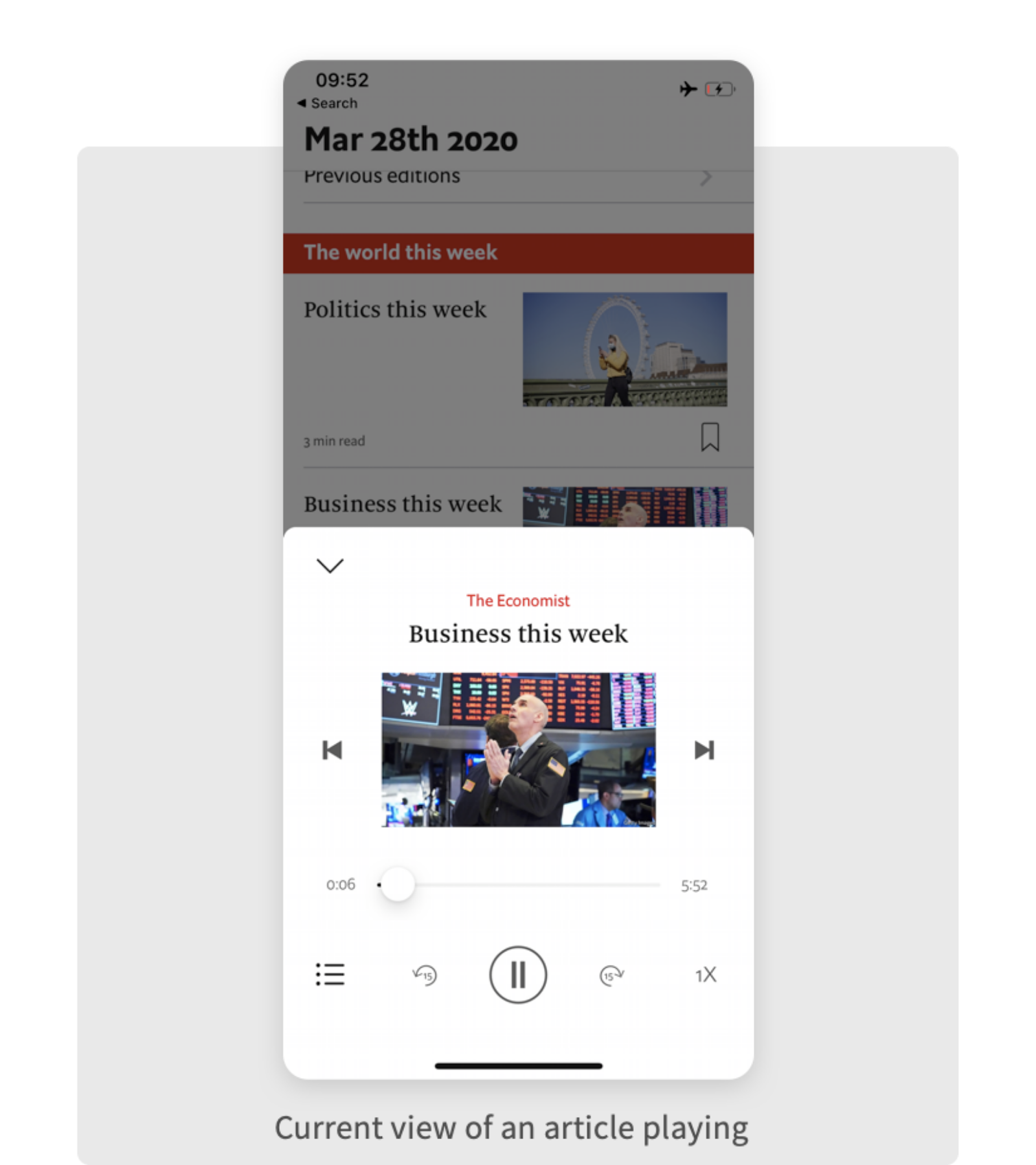
People rarely listen to audio in perfect, controlled conditions.
A subscriber might begin listening at home on Wi-Fi, move onto mobile data, lose signal during a commute, pause from Bluetooth headphones, put the app in the background and return to the same edition hours or days later.
Every transition creates another opportunity for playback to fail, progress to be lost or a listening session to behave unexpectedly.
The Economist needed to understand how its audio experience held up through the conditions subscribers actually encountered.
Our solution
Digivante built test scenarios around genuine listening behaviour rather than relying on a single scripted playback check.
Testing included:
- Network transitions: Moving between Wi-Fi, 3G, 4G and 5G during playback
- Background and foreground playback: Switching app states and using operating-system media controls
- Bluetooth controls: Play, pause, skip and resume through wireless headphones
- Weak connectivity: Testing playback through intermittent signal and recovery after connection loss
- Multi-session listening: Downloading an edition, closing or backgrounding the app and returning to it later
- Real listening journeys: Using other audio apps between sessions and validating the weekly edition’s audio controls
Testing was carried out across multiple browser and platform combinations to see how the experience behaved outside a controlled environment.
The results
Digivante identified 48 issues across the real-world listening scenarios.
Six were classified as high-severity functional defects.
Findings included:
- playback failures during network transitions
- interruptions when switching app states
- progress-tracking problems
- failures to recover a listening session after the app had been closed
Individually, these issues might appear relatively small. Across repeated listening sessions, however, they could make a premium audio experience feel unreliable.
The Economist gained a prioritised view of the problems most likely to interrupt genuine subscriber listening, rather than evidence based only on ideal test conditions.
48
issues identified
6
high-severity defects
The takeaway
“Does the audio play?” is only the beginning of the test.
For The Economist, the important question was whether playback continued to work as subscribers moved through the real world.
Changing networks, losing signal, using Bluetooth controls, backgrounding the app and returning later all created behaviours that a simple functional check could miss.
Real-world testing exposed where those everyday transitions could disrupt the listening experience, giving the team clearer evidence of what needed attention.
FAQs
Why did The Economist bring in Digivante?
The Economist needed to understand how its audio experience behaved in realistic subscriber listening conditions, including network changes, Bluetooth controls, weak connectivity and listening across multiple sessions.
What did Digivante test?
Testing covered network transitions, background and foreground playback, Bluetooth controls, low and intermittent connectivity, downloading audio and returning to listening sessions over several days.
What did the testing find?
Digivante identified 48 issues, including six high-severity functional defects affecting areas such as playback, progress tracking and session recovery.
Why is real-world audio testing important?
Audio may work correctly in a controlled environment but fail when users change networks, lose connectivity, background an app or control playback through another device. Testing those conditions reveals problems that a simple playback check may not expose.