
When ecommerce conversion drops, the first conversation internally is usually a marketing one.
Was the campaign wrong? Was the traffic poor? Did the offer land? Did paid social underperform? Has the audience changed? Is the creative tired?
Sometimes that is exactly where the problem is. Marketing is tricky. It’s constantly changing and it’s easy to get it a little bit wrong, just like any other function.
But looking at the underlying metrics, sometimes a mystery appears… Marketing’s latest campaigns have record-breaking click through rates, cost per click is trending down, engagement rates are nailing it, and open rates are all hitting their marks. So, what’s happening?
There is a bigger issue that often gets missed: marketing may own the conversion rate number on the quarterly report, but it does not own every part of the customer journey that creates that number.
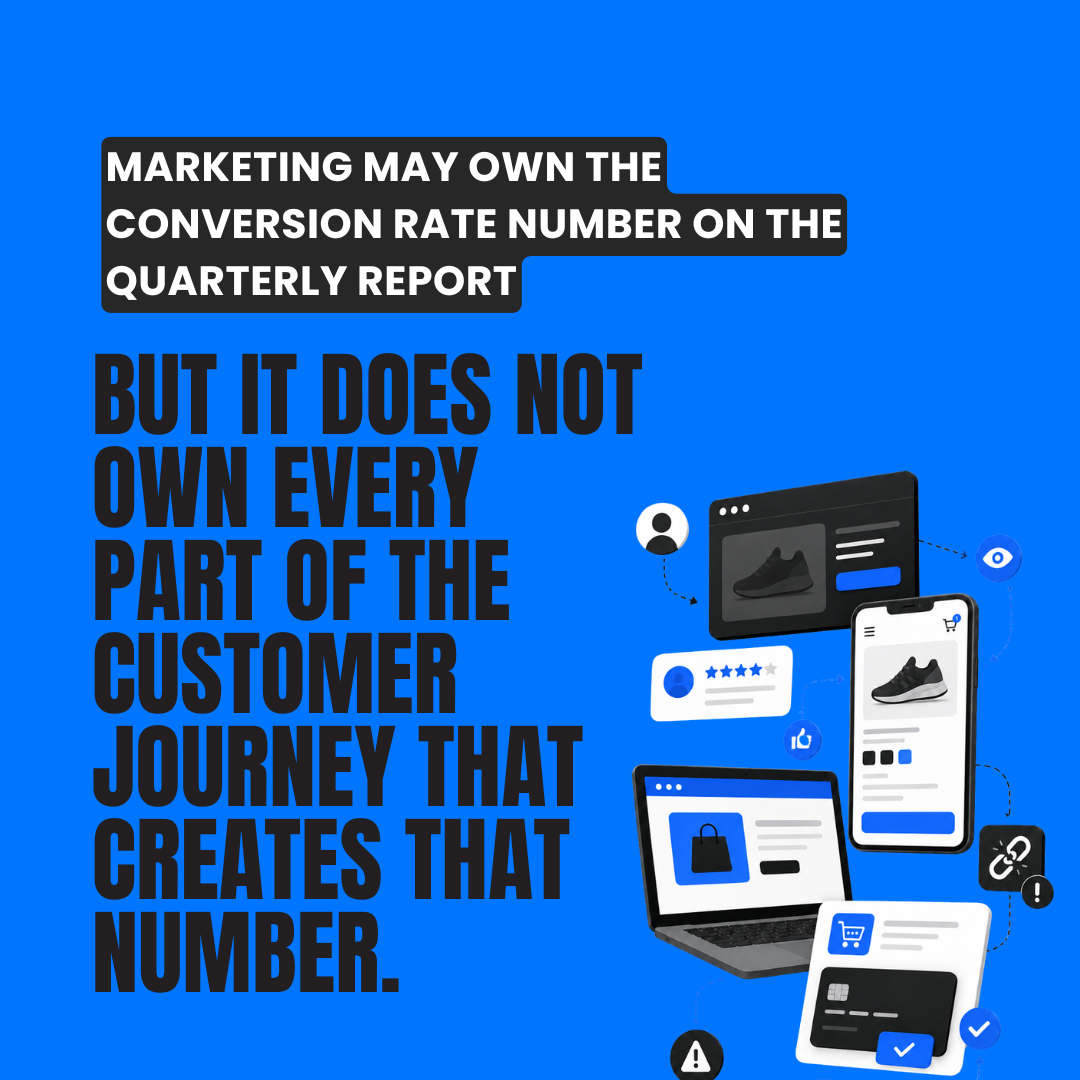
A campaign can do its job perfectly well. It can get the right customer to the right product… at exactly the right time. But if that customer then hits a broken filter, a confusing product page, a promo code issue, a mobile bug, a payment failure, or a checkout journey that behaves differently on their device, marketing still takes the hit in the dashboard. And not only do they not know how to fix it, they usually aren’t able to even identify what it is. Even if they DO manage to identify exactly where it’s going wrong through scouring endless heatmaps, there is almost no authority in the marketing department to tell the dev team what to do to actually fix it!
That is a gap that ecommerce teams need to figure out in order to win in 2026.
Why ecommerce conversion drops are (usually not) a marketing problem
Conversion is usually reported through marketing and ecommerce performance KPI scorecards.
Going down the list: Paid search. Paid social. Email. Organic. Affiliates. Campaigns. ROAS. Revenue. Conversion rate…
So when the number moves in the wrong direction, it is natural to start by investigating the newer campaigns, channels, or audiences. But that should not be the only place teams looks.
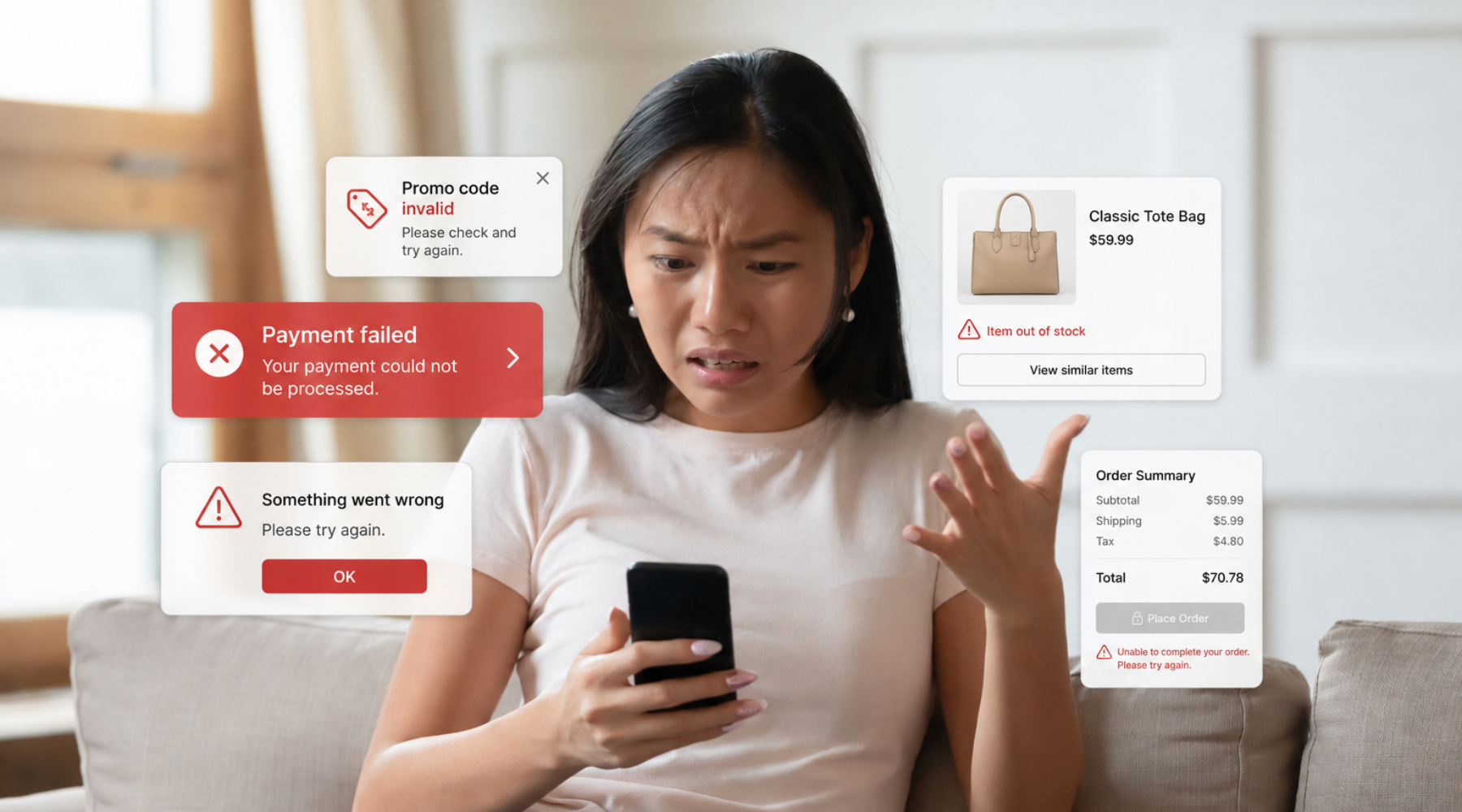
A conversion drop can be caused by the campaign. It can also be caused by what happens after the click. That is why conversion is hard to diagnose properly. It looks like one number, but it is influenced by dozens of small backend decisions across the journey.
A homepage change can affect product discovery in an update nobody even thought twice about pushing live. A search issue can reduce basket adds for the product in the best-performing ad creative. A delivery option can break trust in a moment if it feels outside of their norm. A payment method can fail for a specific group of users, undetected for months before you can figure out what’s happening. A promotion can work in one browser and not another. A release can pass internal checks and still create friction in the real world.
None of those are simple “marketing problems”. But they all become marketing problems when performance drops.
The customer journey creates the number
This is where the blame gets messy.
A campaign goes live (often aligned with a minor code update that passes all internal checks) and conversion drops. The obvious assumption is that the campaign has underperformed, most people don’t even think to question the launch after all the assurances from the CTO down. But when you look closer, the issue might be that one payment method is failing on mobile, or a promo code behaves unexpectedly for returning customers, or a product page change has created an issue on a particular browser.
A replatform or major release goes live and the internal team has signed it off. The core functionality works. The site is live. The project is technically delivered. But real customers are now taking routes through the journey that nobody tested end to end: filtering, comparing, applying offers, changing delivery options, using saved cards, switching devices, or coming back to basket later.
Or an AI search or product recommendation tool is introduced. Internally, it looks like it works because it returns answers. But customers are asking questions in different ways, using vague language, expecting context, and relying on the answer to make a buying decision. Sometimes they’re even trying to straight up break it. If the response is confident but unhelpful, or inappropriate due to specific prompting, the risk is not just technical. It affects the brand at its core: trust, conversion, and customer experience are all at risk.
That is the point.
Analytics and heatmaps tell you the cost after you’ve already paid it
Analytics are useful. So are heatmaps. They show you where something has gone wrong. They show you the drop. They show you the abandoned baskets, the device mismatch, the traffic that landed and then evaporated.
But they only show you this after the impact has started. After the customer has felt the friction. After you’ve lost the sale.
A heatmap shows you that people are clicking a button that doesn’t work. It doesn’t show you that your payment provider changed their response format on a Friday and broke the flow for 15% of transactions. A dashboard shows you cart abandonment spiked on Tuesday. It doesn’t show you that your promo code logic broke for a specific cohort or that checkout looks broken on iPhone 12. Analytics shows the symptom. It doesn’t always show the cause. And by the time you see the symptom in your dashboard, the damage is already done.
This is the uncomfortable reality: marketing is held responsible for a conversion metric that is influenced by dozens of decisions and systems they cannot see, cannot control, and cannot fix. They get blamed for the result while having authority over only a fraction of the inputs.
The dev team can fix the broken button. The payment team can fix the integration issue. The product team can fix the confusing filter. But marketing is the one reporting the number that reflects all of those failures combined.
That is a structural problem.
What it cannot show is what the customer actually experienced in the moment. Not after, not in hindsight through a heatmap, but in real time as they tried to move through your site and hit friction.
That matters because teams can spend a lot of time optimizing the wrong thing. The campaign gets reviewed, the landing page gets debated, the media spend gets adjusted, and the creative gets questioned. Meanwhile, the real issue might be sitting somewhere in the journey after the click.
A small defect in checkout. A broken promo rule. A payment provider issue. A third-party integration behaving unexpectedly. A product detail page that works internally but fails on a specific device. An AI search experience that gives an answer, but not a useful one.
If you only look at the dashboard, you see the drop. You do not necessarily see the friction that caused it.
This is why checkout matters so much. Baymard’s checkout usability research tracks the average global cart abandonment rate at 70.19%, which shows how much value can be lost at the point customers are closest to buying.
Why UAT matters when ecommerce conversion drops
This is another uncomfortable point. A release can pass technical testing and still fail commercially. This is why it matters to understand that QA, UAT, and UX are not the same thing.
The build can be stable. The automated checks can pass. The internal UAT team can follow the expected path and sign it off. But customers rarely behave like internal testers. That is the risk of leaving UAT to internal teams alone.
They use different devices. They combine offers. They mistype things. They go backwards. They abandon and return. They use older browsers. They choose unexpected delivery options. They do not know the neat version of the journey the business has in its head.
That is where the risk sits.
Most teams are not deliberately ignoring this. They are moving quickly, trying to release, trying to improve the site, trying to keep up with customer expectations. But speed creates risk if the only validation is internal.
The real question is not just: “Does it work?” It is: “Does it work for customers, in the real conditions they actually use it?”
That is where customer journey testing and real user testing become important. Not as a replacement for technical QA, but as the layer that validates whether the journey is actually ready for customers.
AI makes ecommerce conversion drops harder to diagnose
The same issue is becoming more obvious with AI.
AI search, AI recommendations, AI product discovery, and AI chatbots all create new customer journey risks. During internal testing, they can look like they are working because they respond.
But a response is not the same as a good customer experience.
Was the answer accurate? Was it useful? Did it help the customer make a decision? Did it create confidence? Did it send them to the right product? Did it understand the context? Did it behave consistently across different types of users?
AI can be very convincing while still being wrong, irrelevant, or unhelpful. For ecommerce teams, that is not a technical issue. It is a commercial one.
NN/Group makes a useful point on this: users need site AI chatbots to solve real problems, not simply exist as another interface. That is the standard ecommerce teams should apply. If an AI experience gives an answer but does not help the customer move forward, it has not really worked.
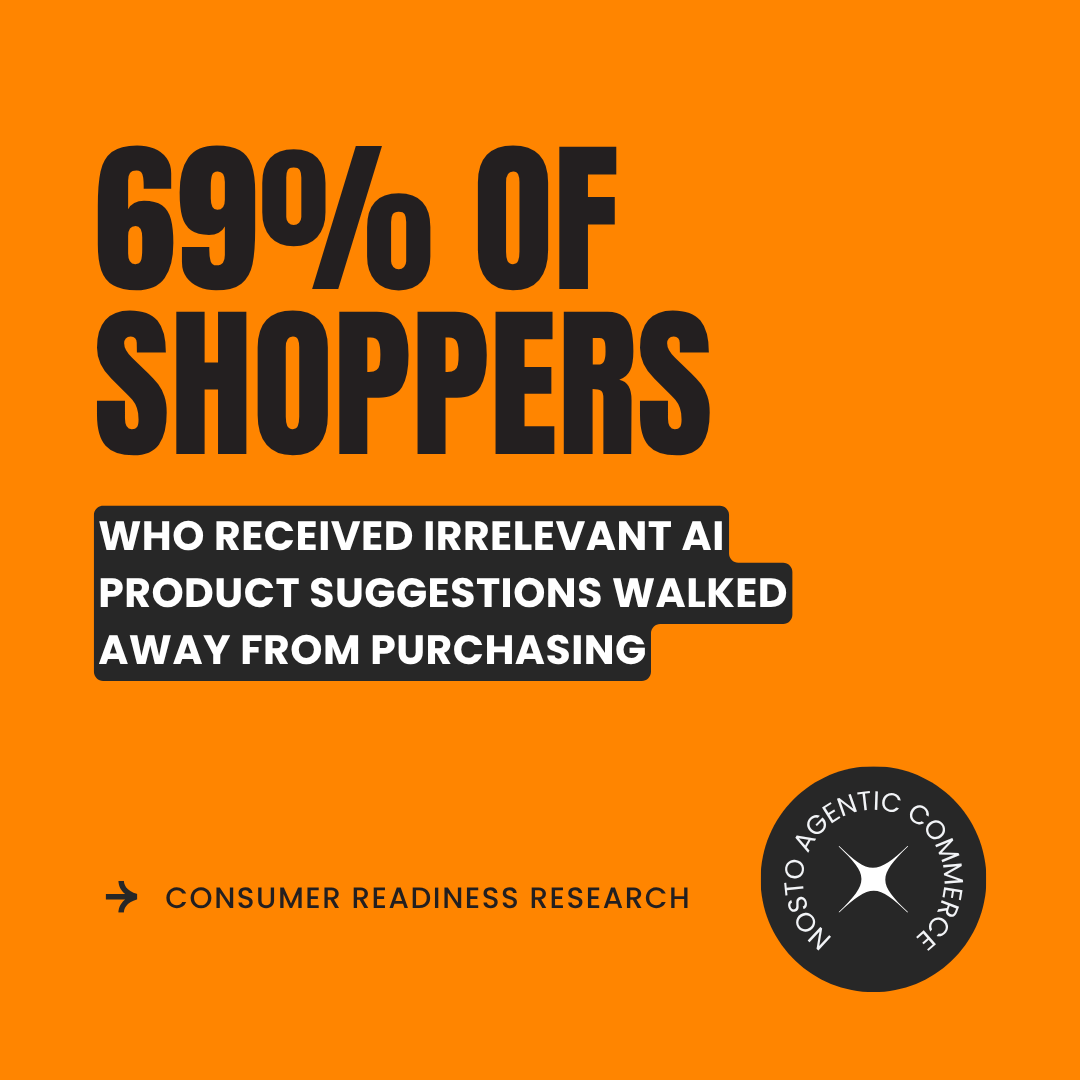
For ecommerce, that risk is especially clear in AI shopping assistants and product recommendations. Nosto’s research found that 69% of shoppers who received irrelevant AI product suggestions walked away as a result. In other words, relevance is not a nice-to-have. It directly affects trust, momentum, and conversion.
And here is where it gets worse: if the AI recommendation is bad, the analytics will show a conversion drop. And once again, marketing will be asked to explain why traffic is suddenly converting worse, when the real issue is that the customer’s experience with an AI system they cannot control has degraded the moment when they were ready to buy.
What to ask before blaming marketing
When ecommerce conversion drops, it is still right to look at marketing. But it should not stop there.
The better question is: “What changed for the customer?”
That includes the campaign, but it also includes the site experience, the checkout, the payment journey, the device experience, the release history, the third-party tools, the promo logic, and increasingly the AI experiences sitting inside the journey.
Useful questions include:
Can customers still complete the key journeys on real devices?
Has anything changed in checkout, payment, promo codes, or delivery?
Are mobile users seeing the same journey as desktop users?
Did the release pass technical checks, or was the full customer journey validated?
Are users taking routes through the site that internal teams did not test?
Are AI search, recommendation or chatbot experiences giving answers that are actually useful?
Is the issue visible in analytics, or only obvious when you watch the journey?
If the customer journey is creating friction, more traffic will not fix the problem. It will just send more people into the same broken experience.
The real issue behind ecommerce conversion drops
Marketing might own the number, but the customer journey creates the result.
That is the distinction ecommerce teams need to get better at making.
If conversion drops, don’t only ask what went wrong with the campaign. Ask what happened after the customer clicked. Because that is often where revenue is won or lost.
And it is where too many teams still rely on internal assumptions, limited UAT, or technical checks that were never designed to show how real customers behave.
The businesses that get this right are not the ones that test more for the sake of it. They are the ones that know which journeys matter most, validate them in real-world conditions, and fix the friction before customers find it first.
Frequently Asked Questions
Why do ecommerce conversion rates drop?
Ecommerce conversion rates can drop for many reasons, including weaker campaign performance, poor traffic quality, pricing changes, competitor activity, checkout friction, mobile issues, payment failures, broken promo codes, product page problems, or recent site releases. The key is to look beyond the marketing dashboard and understand what customers actually experienced in the journey.
Is a conversion drop always a marketing problem?
No. Marketing can influence conversion, but it does not control every part of the customer journey. Ecommerce conversion drops can be caused by product, UX, QA, engineering, payment, platform, third-party, or release issues. Marketing may own the performance number, but the whole customer journey creates the result.
How can ecommerce teams diagnose a conversion drop?
Ecommerce teams should look at campaign performance, analytics, release history, device and browser data, checkout behaviour, payment performance, promo code journeys, and customer feedback. Real user testing can help identify issues that analytics shows as a drop-off but does not fully explain.
Why is UAT important for ecommerce conversion?
UAT is important because technical testing does not always prove that customers can complete the journey successfully. Real customers use different devices, browsers, payment methods, and routes through the site. UAT and real user testing help validate whether the experience works in realistic customer conditions.
Why is UAT important for ecommerce conversion?
UAT is important because technical testing does not always prove that customers can complete the journey successfully. Real customers use different devices, browsers, payment methods, and routes through the site. UAT and real user testing help validate whether the experience works in realistic customer conditions.