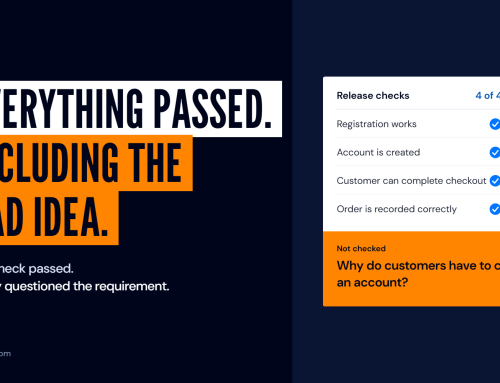
There’s a growing issue in ecommerce that most teams don’t catch early enough.
Conversion drops. Revenue softens. Something feels off.
But when you investigate, nothing looks broken.
Analytics are stable. QA hasn’t flagged anything major. The site is live, functional, and recently tested.
So the assumption becomes: it must be external. Seasonality, traffic quality, pricing pressure.
Sometimes that’s true. But increasingly, the problem sits much closer to home, inside the buying experience itself.
What is the fastest way to test an ecommerce website?
The gap between browsing and buying
Ecommerce teams have spent years optimising how sites look.
Landing pages are refined. Navigation is clean. Product pages are polished.
But far fewer teams have truly stress-tested how their sites sell.
Because the reality is, most issues don’t appear when someone is browsing.
They appear at the point of intent, when a customer is trying to complete a purchase.
And that’s where things quietly break down.
One of the main reasons conversion drops go undetected is the lack of real-user validation. Many teams rely on internal QA, when in reality they need fast ecommerce site reviews using real users to uncover issues that analytics alone cannot
Why “nothing’s broken” is a dangerous assumption

Traditional testing is built to find binary problems: Broken buttons, failed transactions, clear functional defects. But modern ecommerce issues are rarely that loud. Instead, they show up as small moments of friction:
- A payment method that fails under specific conditions
- A form that behaves differently on certain devices
- A delay that causes hesitation at checkout, something even Google highlights in its Core Web Vitals research
- A layout shift that makes it harder to complete a purchase
Individually, these don’t register as critical bugs.
But collectively, they have a measurable impact on conversion.
Customers don’t report them. They don’t trigger alerts. They just leave.
Checkout is now the highest-risk area
The biggest risk area for most ecommerce brands today isn’t the homepage or product pages.
It’s checkout.
Over time, focus areas shifted. Several years ago, localisation testing was a major concern. Translation quality, cultural context, and suitability of imagery all required close attention. As translation tools and content workflows have improved, many of those risks have reduced, but have not disappeared entirely.
Accessibility followed a similar pattern. As regulations tightened, particularly across Europe, organisations have become more proactive about validating standards and compliance.
What never truly became simpler is payment.
Despite advances in automation, simulators, emulators, and AI-assisted testing, one critical boundary remains untouched. None of these tools place live transactions through real banking systems.
- They do not authenticate with local banks.
- They do not interact with region-specific wallets.
- They do not expose how address rules, character sets, or regulatory checks behave in production.
This is where modern testing strategies still fall short.
To address this, teams are increasingly using ecommerce QA solutions that provide real user feedback, including affordable options that allow targeted testing without large budgets.
What in-country live testing actually validates
In-country testing is often misunderstood as broad international UX testing. In practice, its most valuable use today is far more focused.
It validates whether customers can actually complete a payment. A real tester, based in the target country, places a genuine order using local payment methods. This happens on real devices, under real network conditions, using the same flows customers experience.
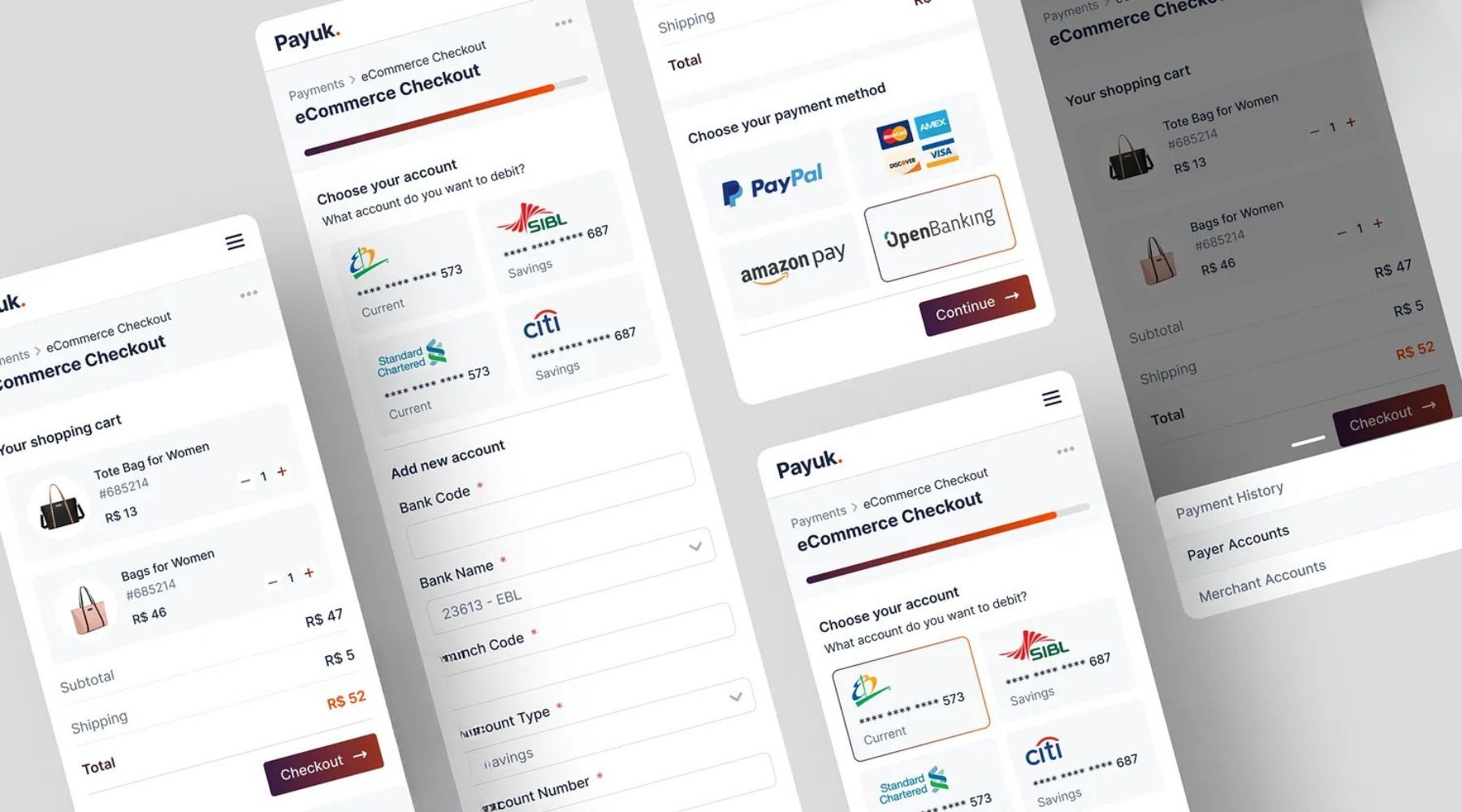
Research from the Baymard Institute consistently shows that checkout usability remains one of the biggest drivers of abandoned purchases.
As ecommerce expands globally, checkout flows have become more complex:
- Multiple payment providers
- Local payment methods
- Regional behaviours and expectations
- Different device and browser combinations
A journey that works perfectly in one environment can fail (or degrade) in another, particularly when payment methods vary by region.
👉 The international payment problem most testing strategies still miss
For example, a checkout that performs well in the UK may behave very differently for a customer in Germany using Klarna, or in the US using Apple Pay.
And unless you’re testing in those real conditions, you won’t see it.
The visibility problem
Most of these issues don’t show up clearly in analytics.
They don’t break journeys completely. They don’t always generate errors.
They sit in the grey area:
- Increased hesitation
- Higher drop-off at specific steps
- Lower conversion without a clear cause
From a reporting perspective, it looks like normal fluctuation.
From a customer perspective, it’s friction.
From a commercial perspective, it’s lost revenue.
If you’re seeing conversion drops but can’t pinpoint why, it’s rarely guesswork.
Our latest benchmark report breaks down where ecommerce sites are losing revenue, based on real-world testing across thousands of journeys.
👉 Read the report: The Ecommerce Paradox – why your checkout process is losing sales

Speed vs. understanding
Ecommerce teams are shipping faster than ever.
New features, updates, and releases are happening at pace.
But speed without real-world visibility creates massive risk.
Because testing in controlled environments doesn’t reflect how customers actually behave:
- Different devices and browsers
- Unstable networks
- Real payment scenarios
- Non-linear journeys
The result is a growing gap between what teams think they’ve tested and what customers actually experience.
This shift is part of a wider change in ecommerce, where complexity is increasing faster than most testing strategies can keep up.
Closing the gap with real-world testing
The brands that are getting ahead of this aren’t just testing more.
They’re testing differently through exploratory testing.
They’re moving beyond controlled QA and asking a more important question:
“Does this work for real customers, in real conditions?”
That means:
- Testing across a wide and real-time devices
- Validating checkout with real-world payment testing
- Running exploratory tests based on real user behaviour
- Identifying friction, not just functional failure
This is where approaches like exploratory testing become critical, uncovering issues that structured test cases often miss.
👉 Learn more about exploratory testing in ecommerce QA
Because in today’s ecommerce environment, the biggest risks aren’t always visible.
The bottom line
“Nothing’s broken” is no longer a reliable signal of performance.
If your ecommerce testing strategy isn’t built around real-world usage, there’s a strong chance you’re missing the issues that actually impact conversion.
And when those issues sit in checkout, the cost isn’t technical.
It’s commercial.